

Executive Summary
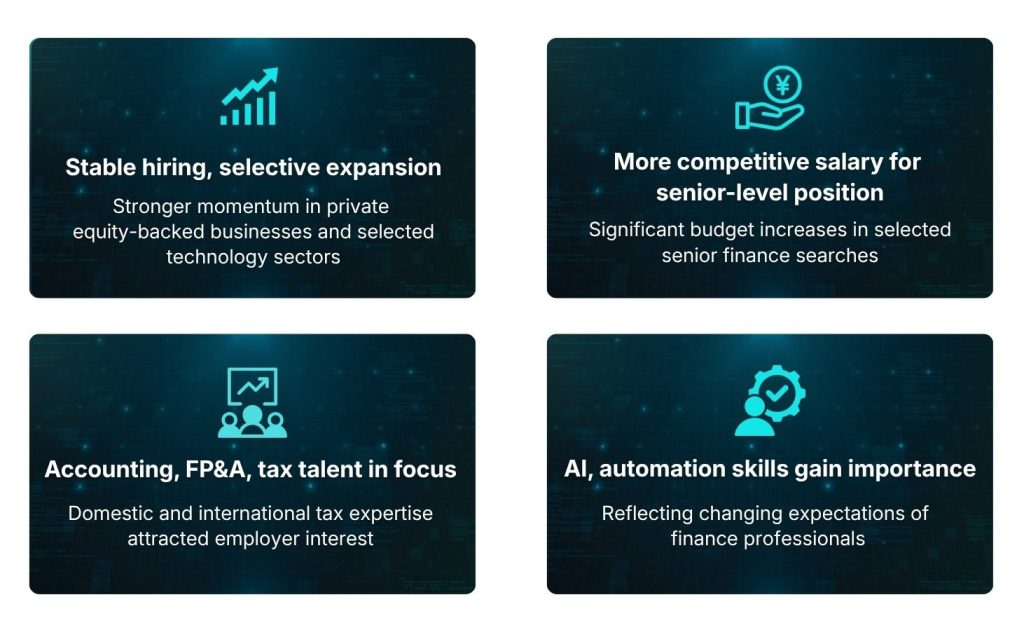
Japan’s Finance & Accounting recruitment market remained broadly stable in Q3 2026, with selective growth driven by private equity activity, technology investment, and demand for specialized finance expertise.
Accounting Managers, FP&A professionals, and tax specialists remained in demand, while employers increasingly valued experience in AI, automation, business transformation, and complex stakeholder reporting. Compensation for selected senior finance positions also became more competitive, supported in some cases by the weaker yen and increased investment activity.
On the candidate side, higher salaries, career progression, and broader responsibilities remained key motivations for considering new opportunities, although company stability, reputation, and workplace flexibility continued to influence decisions.
Looking ahead to Q4, demand for accounting and interim professionals is expected to remain resilient as businesses prepare for year-end reporting. Meanwhile, recent volatility in global AI-related markets and potential policy developments following the US midterm elections introduce additional factors that may influence investment decisions and recruitment priorities in Japan.
Part 1: Employer Hiring Trends
1. Stable Market. Stronger PE Momentum
Overall, Japan’s Finance & Accounting recruitment market remained stable in Q3 2026, with stronger activity in private equity-backed businesses.
Our consultants observed increased recruitment linked to acquisitions of Japanese companies, particularly for CFOs and senior finance leaders. The weaker yen, alongside Japan’s focus on corporate governance and capital efficiency, may be contributing to this investment activity.

As businesses navigate ownership changes, demand is growing for finance professionals capable of strengthening financial controls, improving reporting processes, and supporting operational transformation. Private equity-backed organizations are particularly interested in CFOs who can manage complex stakeholder expectations, drive business performance, and provide clear financial visibility to investors.
2. Accounting and FP&A Remain Core Hiring Priorities
Accounting Managers and FP&A Managers remained among the most sought-after professionals in Q3 2026. Employers prioritized technical accounting expertise, accurate financial reporting, business partnering, and analytical capabilities that support strategic decision-making.
Growing Interest in In-House Tax Capabilities
We also observed increased interest among Japanese listed companies in strengthening their tax functions, particularly in domestic and international taxation, transfer pricing, and tax governance.
This development may reflect the growing complexity of overseas operations, currency fluctuations, and regulatory requirements. As businesses expand internationally, tax professionals are increasingly expected to contribute to risk management and strategic planning.
3. Technology, AI, and Robotics Continue to Attract Hiring Interest
Technology-related businesses, particularly in AI, SaaS, and robotics, were the most active in Q3 recruitment discussions. Investment in automation continues to reshape finance functions, increasing the emphasis on analytical capabilities and process efficiency. Our consultants observed a growing demand for finance professionals with experience in automation, particularly within the FP&A function. Employers value candidates who can streamline reporting, improve forecasting, and support data-driven decision-making.

4. Employers Are Seeking More Specialized and Commercially Minded Finance Professionals
A key hiring challenge in Q3 was the limited availability of finance professionals combining technical expertise with strategic and operational capabilities. Employers increasingly sought candidates experienced in AI, automation, and process improvement. Private equity-backed businesses placed particular emphasis on finance leaders capable of managing complex reporting structures, meeting investor expectations, and driving business transformation. Candidates with combination of technical knowledge, commercial awareness, and stakeholder management skills remain relatively scarce in Japan, making recruitment for these specialized roles particularly challenging.

5. Compensation Budgets Show Greater Flexibility for Senior Finance Roles
Our consultants observed increased salary budget flexibility in selected senior finance searches during Q3 2026, with some employers offering substantially higher compensation than in previous hiring exercises.
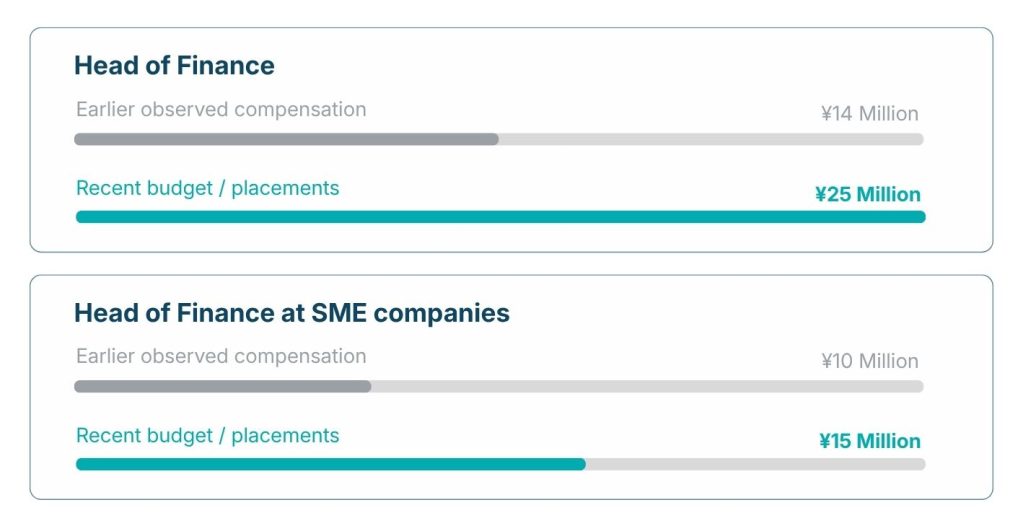
Several factors may contribute to this development, including the weaker yen improving foreign-affiliated companies’ purchasing power, increased financial resources following acquisitions, and broader responsibilities for senior finance leaders. Employers also demonstrated willingness to offer premium compensation for scarce skills and specialized experience. However, this flexibility varies across organizations and should not be interpreted as a market-wide trend.

Part 2: Talent Movement and Candidate Trends
1. Candidates Remain Open to Opportunities, but Many Are Not Actively Searching
Candidate activity during Q3 remained broadly consistent with Q2 2026. Most candidates were generally satisfied in their current positions but remained open to exploring attractive opportunities. Many did not have an immediate reason to leave their current company.
However, the possibility of a significant salary increase, broader responsibilities, or stronger career progression could encourage them to consider a move, especially among senior and specialized professionals.

2. Compensation and Career Progression Remain Leading Motivations
Higher compensation, career advancement, and broader responsibilities remained key motivations for job changes in Q3, although priorities varied by seniority and professional background.

Internationally Experienced Professionals
Japanese professionals returning from overseas assignments often favored international environments offering greater decision-making authority, broader responsibilities, and opportunities to leverage their global experience.
Senior Finance Leaders and CFOs
At CFO level, career moves were often driven by more than compensation. While some executives remained comfortable in their current roles, others became open to new opportunities after completing major projects or business transformations. The prospect of new challenges, strategic influence, and leadership opportunities could be equally important in motivating a move.
3. Accounting Managers Remain Among the Hardest Profiles to Secure
Accounting Manager positions continued to present recruitment challenges during Q3.
Employers frequently sought professionals with strong technical accounting knowledge, management experience, and relevant professional qualifications, including:
- US Certified Public Accountant (USCPA)
- Japanese Certified Public Accountant (JCPA)
- Japan Bookkeeping Certification, Level 2 (日商簿記2級)
4. Candidates Are Evaluating Opportunities Beyond Salary
Beyond compensation, candidates continued to prioritize career progression, role scope, company reputation, stability, and workplace culture.
We observed varying preferences: some professionals favored established organizations offering structured development, strong benefits, and international mobility, while others preferred start-ups providing broader responsibilities and new challenges.

In some cases, candidates declined competitive offers due to concerns about organizational fit or long-term prospects. Personal circumstances also influenced decisions, with workplace flexibility, location, and commuting convenience becoming particularly important for professionals balancing career and caregiving responsibilities.
5. Remote-Work Expectations Are Evolving
Remote-work expectations appeared to moderate compared with 2025, with more candidates accepting office-based arrangements provided some flexibility remained. For many, one remote-working day per week or occasional flexibility was sufficient.
Our consultants observed some foreign-affiliated companies increasing office attendance, while certain large Japanese organizations maintained flexible policies to retain talent.
Location also influenced preferences, with flexible arrangements remaining particularly valuable for employers outside central business districts, where longer commutes could affect candidate interest.
Part 3: Q4 2026 Recruitment Outlook
1. Accounting and Interim Recruitment Expected to Remain Active
As we enter the final quarter of 2026, our consultants anticipate continued demand for accounting professionals across Japan. We also expect short-term and interim recruitment to become increasingly relevant as organizations prepare for year-end financial activities and reporting requirements. Businesses may require additional resources to manage accounting workloads, cover unexpected departures, or maintain continuity during busy periods.
2. Global Market Developments and Potential Impact on Japan
Recent developments in global technology markets and the US political landscape may influence Japan’s economic and recruitment environment in Q4 2026.
AI Investment and Market Volatility
According to recent news, growing concerns over AI valuations and investment sustainability have contributed to market corrections in China and volatility in US technology stocks. While it remains unclear whether these developments signal a broader downturn, it could potentially affect investment confidence and hiring decisions, particularly in technology and AI-related industries.

US Midterm Elections and Policy Developments
The November 2026, US midterm elections resulted in Democratic majorities in both chambers of Congress, introducing a new political dynamic for the remainder of President Trump’s term. The outcome has raised questions about future fiscal policy, trade relations, technology regulation, and government oversight of AI infrastructure development.
For Japanese businesses with significant US operations, international investment exposure, or close ties to global technology supply chains, changes in US policy could influence business planning and investment priorities. However, the extent and direction of these effects remain uncertain and will depend on subsequent policy decisions and broader economic conditions.
What Does This Mean for Finance and Accounting Recruitment in Japan?
These global developments may influence some employers to adopt a more cautious approach to investment and workforce planning. At the same time, periods of market uncertainty like this may reinforce the importance of strong financial management, cash flow forecasting, risk assessment, and operational efficiency. This could support continued interest in experienced Finance & Accounting professionals, especially those capable of helping organizations navigate complex financial environments.
Final Thoughts: Stable Hiring, but the Definition of Finance Talent Is Evolving
Q3 2026 highlighted a stable but evolving Finance & Accounting recruitment market in Japan. While overall hiring activity remained steady, private equity investment, technological developments, and increasingly complex business requirements continued to shape employer demand.
As organizations prepare for year-end activities, accounting expertise, financial planning, and operational efficiency are expected to remain important priorities. At the same time, developments in global technology markets and the US political landscape may influence business confidence, workforce planning, and hiring strategies in the coming months.
For employers, competitive compensation, efficient recruitment processes, and clearly defined role expectations remain important in attracting talent. For candidates, technical expertise combined with adaptability, commercial awareness, and emerging technology skills may strengthen career opportunities.
Trusted Partners will continue monitoring these developments and sharing insights from our consultants to help employers and finance professionals navigate Japan’s changing recruitment landscape.
Disclaimer: This report reflects qualitative observations and insights gathered by Trusted Partners’ recruitment consultants through their market interactions and recruitment activities during Q3 2026 (July–September). It is intended to provide an informed perspective on hiring trends and candidate behavior, rather than statistically representative market data. Individual compensation examples are illustrative and should not be interpreted as general salary benchmarks.