
Executive Summary
Japan has historically moved cautiously with technology adoption in the workplace. That hesitancy appears to be changing.
Our survey findings have shown that Finance and Accounting professionals in Japan are actively embracing the use of AI, and it is already helping them become more productive. The functions benefiting most are financial reporting, forecasting, and analysis.
What emerges most strongly, however, is a shared consensus about the human side of the equation. Respondents agree that strategic thinking, business partnering, communication, and leadership are becoming more important as AI takes on more of the technical and repetitive work. Our Finance and Accounting professionals are not worried about being replaced. They are focused on being better.
The conclusion we draw from this survey is that the best Finance professionals will be the ones who know how to use AI effectively, question its outputs and apply the results to complex business decisions.
Market Context
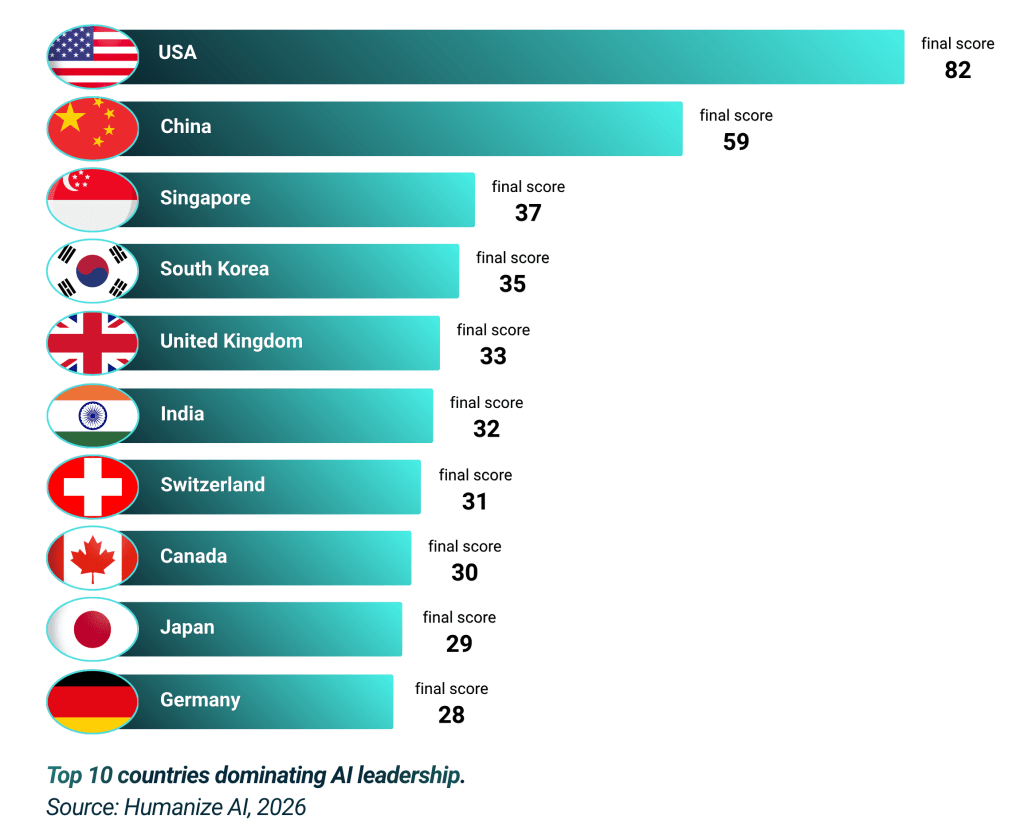
Top 10 Countries Dominating AI Leadership
Japan ranks ninth with a final score of 29 out of 100 for AI brain / leadership, reflecting strong infrastructure and applied AI capability, particularly in industrial and robotics-driven sectors. While its academic scale in AI is limited, its deployment capacity remains one of the strongest in the top ten (Humanize AI, 2026).
AI Adoption Rate in Japan
Surprisingly, Japan’s AI adoption rate sits at 22.5% as of Q1 2026, ranking it 48th globally (Visual Capitalist, 2026). This places Japan at 48th place, well below leading adopters such as the UAE at 70.1% and Singapore at 63.4%, and behind every country in the global top 10, the lowest of which, Qatar, stands at 41.8%.
AI in Japan’s Finance & Accounting Function
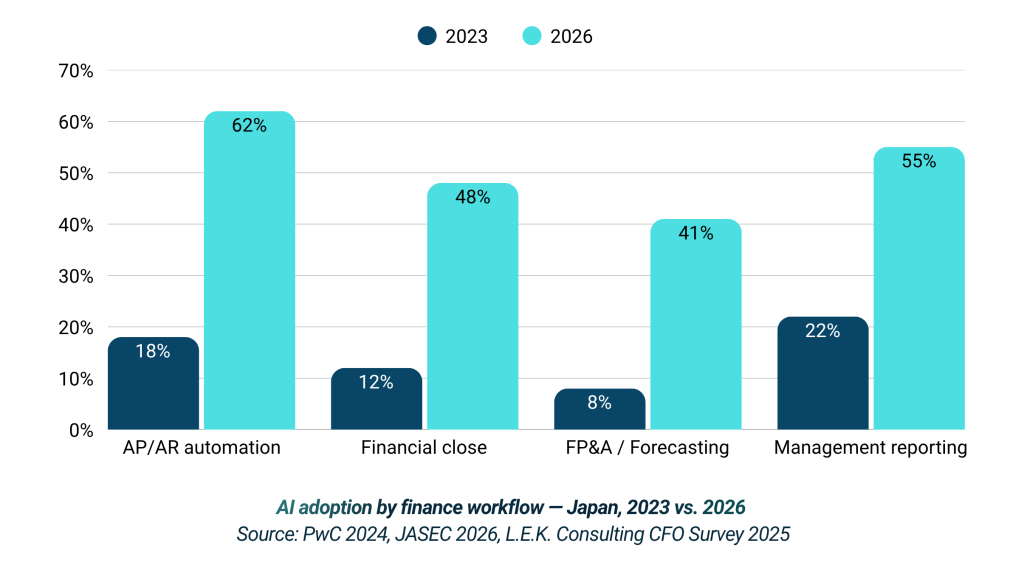
We will discuss this topic further using our survey results in a later chapter. In this section, we will look into data / information from research and reports conducted by organizations in Japan in 2026.
Research from JASEC (2026), PwC (2024) and L.E.K. Consulting’s 2025 Office of the CFO Survey document growing AI integration in Japan’s finance workflows.
The clearest, fastest returns come from the parts of finance that are high-volume, document-intensive, and rule-bound. Accounts payable, invoice processing, expense management, and month-end reconciliation are where the business case is most straightforward and where companies are already seeing documented results.
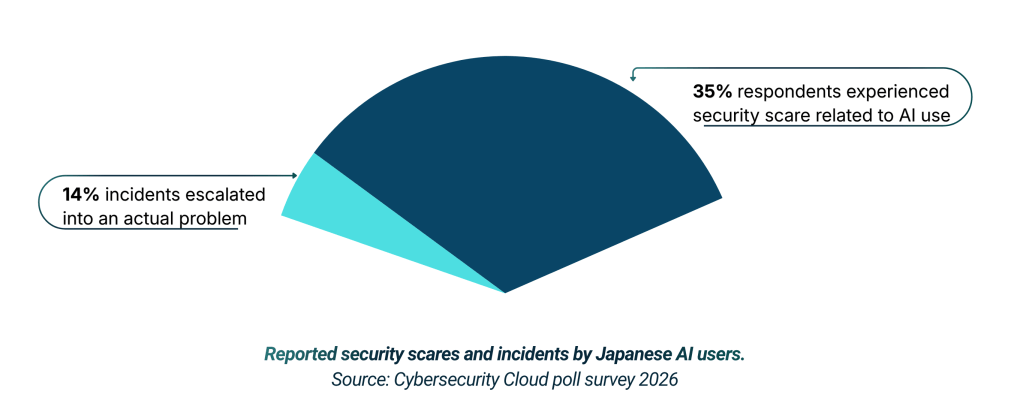
Governance is struggling to keep pace: A Cybersecurity Cloud poll found that over 60% of Japanese AI users have shared internal financial and customer data with AI tools, and 35% reported a related security incident.
AI in Finance & Accounting Survey Analysis & Findings
Japan has been historically cautious of changes, however, when it comes to AI, we are seeing changes in many different ways. The same thing applies to the Finance & Accounting function in Japan.
To better understand this shift, Trusted Partners conducted “AI in Finance & Accounting in Japan” survey in Q2 2026, targeting Finance and Accounting professionals within our professional network in Japan.
This section presents what Finance and Accounting professionals in Japan are feeling towards the AI changes in the function, as well as insights to help organizations and individuals stay aligned with the changes in the age of AI.
87% Report Improved Productivity
- 93% of respondents are already using AI at work, either regularly or occasionally.
- Almost every respondent reported positive productivity gains from AI. 40% reported significant productivity improvements, while 46.7% reported moderate improvements. This suggests that AI adoption among Finance professionals may be progressing more rapidly than many organizations realize.
- The productivity upside of moving from occasional to regular, structured use is significant. The question is no longer ‘should we use AI?’ but it is ‘are we using it well enough?‘
More Finance Functions Enhanced with AI Adoption
- While much public discussion focuses on predictive analytics, respondents reported immediate benefits from AI’s ability to streamline reporting, documentation, data processing, and routine analytical work.
- The results suggest that AI’s immediate impact is operational rather than transformational. Finance teams are leveraging AI to improve reporting, accelerate analysis, support planning processes, and reduce manual workloads.
- 2.6% of respondents cited treasury as a function enhanced by AI, and this absence is notable. It may reflect systems integration complexity and limited AI tool availability for treasury in Japan.
Human Skills Are Becoming More Important, Not Less
One of the strongest themes throughout the survey is the growing importance of human-centred skills.
- Notably, every respondent selected business partnering and communication as a critical future capability. Interestingly, technical accounting knowledge ranked lower than interpersonal and strategic capabilities.
- As AI automates routine work, Finance professionals are expected to spend more time influencing decisions, engaging stakeholders, and providing strategic guidance.
- The valuable skill shifts to capabilities that AI cannot replicate: judgment, communication, leadership, and strategic influence. The Finance professional of the future looks more like a business partner than a technical specialist.
- The future Finance leaders will likely require both technological literacy and strong commercial judgment.
Career Concerns Remain Moderate
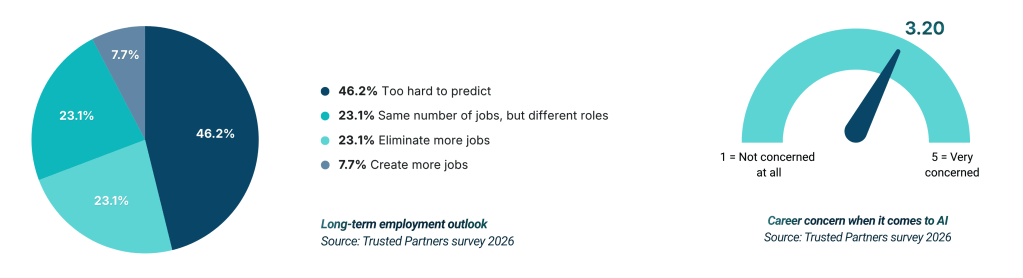
- Respondents generally expressed moderate concern regarding AI’s impact on their careers over the next five years.
- Most respondents selected the middle point on the concern scale rather than extreme positions.
- This suggests that professionals recognize AI’s transformative potential while remaining confident that human expertise will continue to play an essential role.
- The results indicate adaptation rather than fear.
- Finance professionals appear focused on evolving their skillsets rather than resisting technological change.
The Long-Term Workforce Impact Remains Uncertain
- When asked whether AI would create more jobs or eliminate more jobs within Finance & Accounting, respondents demonstrated genuine uncertainty.
- Nearly half stated that it is still too early to predict the long-term impact.
- What respondents do agree on is the direction of change: the nature of finance work is shifting, and the skills premium is moving toward judgment and leadership, regardless of the net employment outcome.
- Routine tasks may become increasingly automated, while demand grows for professionals capable of interpreting insights, influencing business decisions, managing technology, and leading organizational change.
Trust Remains the Biggest Barrier
- Notably, concerns around output quality and judgement ranked higher than fears of job loss.
- These concerns align with global sentiment. Stanford HAI’s 2026 AI Index Report notes that documented AI incidents rose to 362 globally in 2025, up from 233 in 2024. In Japan, a Cybersecurity Cloud survey found that over 60% of AI users have fed internal financial data into AI tools, 35% reported a related security incident. Among those, 14% incidents escalated into an actual problem.
- This highlights the growing importance of governance, review processes, and responsible AI implementation.
Is Japan Falling Behind?
- More than half of respondents (53%) view Japan as behind global peers in adopting AI in Finance & Accounting. This broadly aligns with Japan’s actual 48th global ranking at 22.5% adoption.
- Despite concerns regarding Japan’s overall position, individual respondents reported high levels of personal AI usage and positive experiences.
- This may suggest that adoption at the employee level is progressing faster than organizational transformation and governance.
- For many employers, the risk is no longer adopting AI too early, but adopting too slowly.
The Human Advantage
In the open-ended question, without prompting, our respondents showed a consistent theme: AI is a capable tool, but human judgement, process knowledge, and critical thinking remain essential.
What This Means for Employers
Accelerate Practical Adoption: Employees are already using AI. Organizations should move beyond experimentation and establish structured adoption strategies that maximize productivity gains.
Invest in Human Skills: Communication, business partnering, leadership, and strategic thinking are becoming increasingly important differentiators. Technical expertise alone will not be sufficient.
Strengthen Governance: As adoption increases, organizations must ensure appropriate controls around data security, output validation, compliance, and responsible AI usage.
What This Means for Employers
Rather than replacing finance expertise, AI appears to be elevating expectations around how that expertise is applied. Finance professionals should focus on becoming both technologically capable and strategically valuable. The most successful professionals will likely combine:
- AI literacy
- Strong analytical capabilities
- Business acumen
- Leadership skills
- Communication effectiveness
Share this article
More to explore

Finance & Accounting Recruitment – 2026 Half Year Review
How has Finance & Accounting recruitment changed in H1 2026? Explore market trends, salary shifts, in-demand roles, and what to expect in the second half of the year.

AI in Finance & Accounting in Japan — Survey Report 2026
Download our 2026 survey report on AI adoption in Japan’s Finance & Accounting profession. Insights from finance professionals on productivity, skills, concerns, and what comes next.

The CFO in the Age of AI
From AP automation to real-time forecasting, Japan’s CFOs are navigating AI transformation. See what’s working, what isn’t, and what separates the leaders.

AI in Hiring & Job Search: Finance & Accounting in Japan
41.8% of Japanese job seekers already use AI in their search. But employers are catching up. Here’s what finance and accounting professionals in Japan need to know about the AI hiring shift and how to stay ahead of it.

The Finance Market is Moving. Are you ready?
What’s driving Japan’s Finance & Accounting talent market in Q1 2026? Bilingual hiring trends, salary shifts, in-demand roles, and what to expect in Q2 from Trusted Partners’ consultants.

Common Hiring Mistakes in Finance Leadership And How to Avoid them
One wrong move in senior F&A hiring and you’re starting over months later, with the same urgency and a shorter shortlist. The stakes are high. The margin for error is low.