
Finance and Accounting Recruitment

2026 Mid Year Review

Executive Summary

Q1 2026 Recruitment Trend Highlights

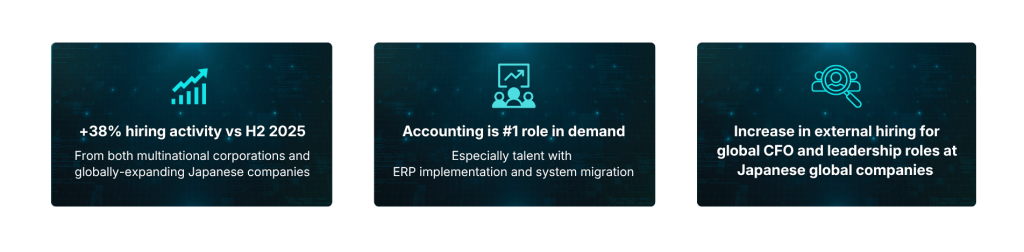
Japan’s Finance & Accounting recruitment activity remained resilient in H1 2026. Job volume climbed 38% versus H2 2025. The demand came from both multinational corporations and globally-expanding Japanese companies. 

The most notable structural shift this half is at the top of the finance function: Japanese global companies are increasingly recruiting Global CFOs and second-level finance leaders from outside the organization, a departure from the traditional reliance on internal progression. This is being driven by a need to stay competitive globally, strengthen the finance function, and improve shareholder value. Alongside this, demand for bilingual accounting leaders has grown, reinforcing a bilingual talent shortage that continues to shape sourcing strategy across the market.  

Accounting remains the most in-demand function overall. Employers increasingly want professionals who can also lead ERP implementations, manage projects, and act as genuine business partners. 

Companies that streamline their interview process are landing the strongest candidates. Employers are competing more through sign-on bonuses, additional perks, and clearly defined flexibility policies than through base salary increases. 

Looking ahead to H2 2026, we expect Accounting demand to stay strong as companies approach year-end, though processes may slow through August due to Obon holiday in Japan and summer holidays in Europe and the US.

Employer Market

1. Demand by Roles

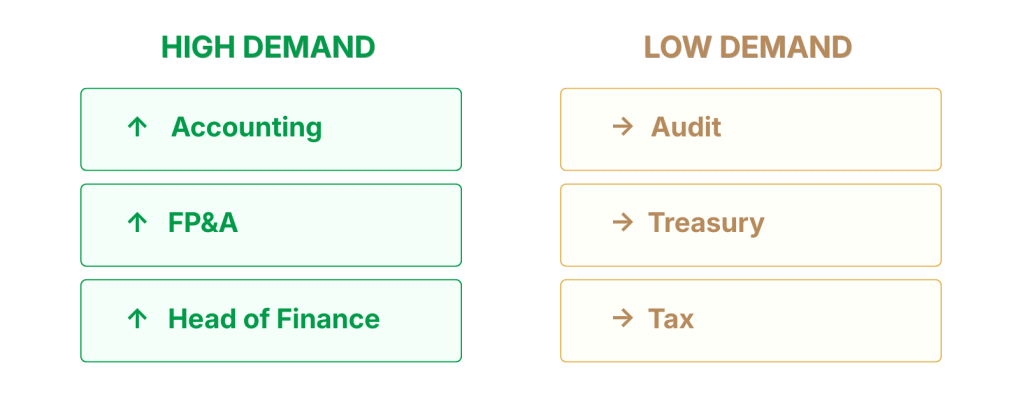
Most In-demand Finance Roles in Japan H1 2026

Accounting was the single highest-demand function in H1 2026, followed by FP&A and then Head of Finance. In comparison, recruitment activity for Audit, Treasury, and Tax saw declining demand over the same period.

2. Demand by Skills

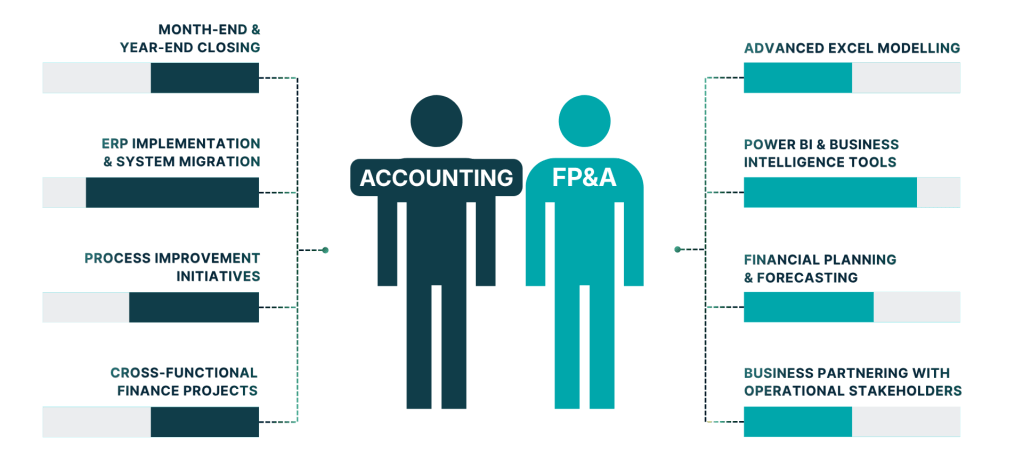
Most In-demand Skills Among Finance Professionals in Japan

While technical accounting knowledge remains fundamental, employers are increasingly looking beyond traditional finance skills.

Leadership positions increasingly require professionals who can balance strategic thinking with operational execution.

Skill Gap: The clearest gap is hands-on execution capability at leadership level. Many leaders who have transitioned into people-management roles struggle when hands-on tasks are still required of them.

3. Hiring Challenges

Hiring speed

Time-to-hire was broadly similar to Q1 2026 and H2 2025, but companies that streamlined their interview process and prioritized speed were more successful in securing top candidates.

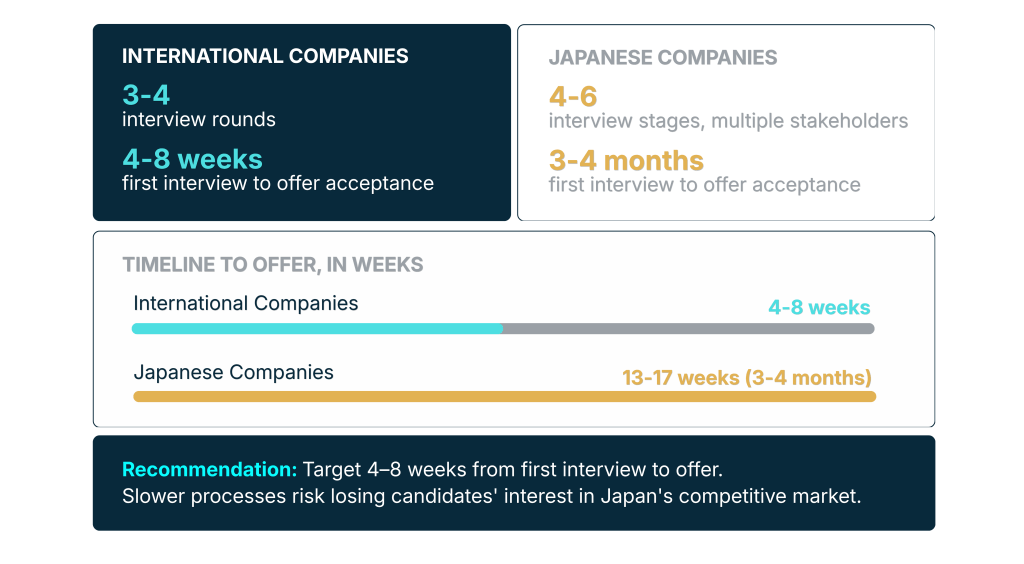
Hiring timeline at international companies vs. Japanese companies

Multinational corporations (MNC) typically conduct 3-4 interview rounds, allowing many hiring processes to be completed within 4-8 weeks from the initial interview to offer acceptance. 

By comparison, Japanese companies often follow more traditional hiring structures involving 4-6 interview stages, multiple stakeholder interviews, and longer internal approval processes. Consequently, recruitment timelines can extend to 3 or even 4 months

We recommend clients target 4-8 weeks from first interview to offer. Beyond the risk that a slower process simply loses the market’s interest, there are several compounding reasons to move quickly. 

  • Qualified F&A candidates are routinely fielding more than one offer in the current market, so every extra week of process directly increases the odds of losing a strong candidate to a faster-moving competitor.  

  • Most senior finance candidates are not actively job hunting to begin with, so a long process gives them more time to reconsider and simply stay in their current role.  

  • A drawn-out or unclear process can also read as disorganization or a lack of urgency, which undermines the candidate’s confidence in both the role and the company.

Workplace Flexibility & Clarity

Since Q1 2026, many companies have required employees to return to the office at least three days a week, with some mandating four or five. Yet even as flexibility narrows, employers increasingly recognize that workplace flexibility remains a key lever for attracting and retaining talent. Hybrid working is expected to stay the market standard, with most organizations continuing to offer at least one remote day per week. 

However, our conversations with candidates suggest that clarity is often more important than flexibility itself. Candidates are wary of accepting offers with informal or undefined work from home arrangements, concerned that such policies could be rolled back after they join. Employers with clearly defined flexibility policies are outperforming those offering flexibility informally.

4. Compensation & Benefits

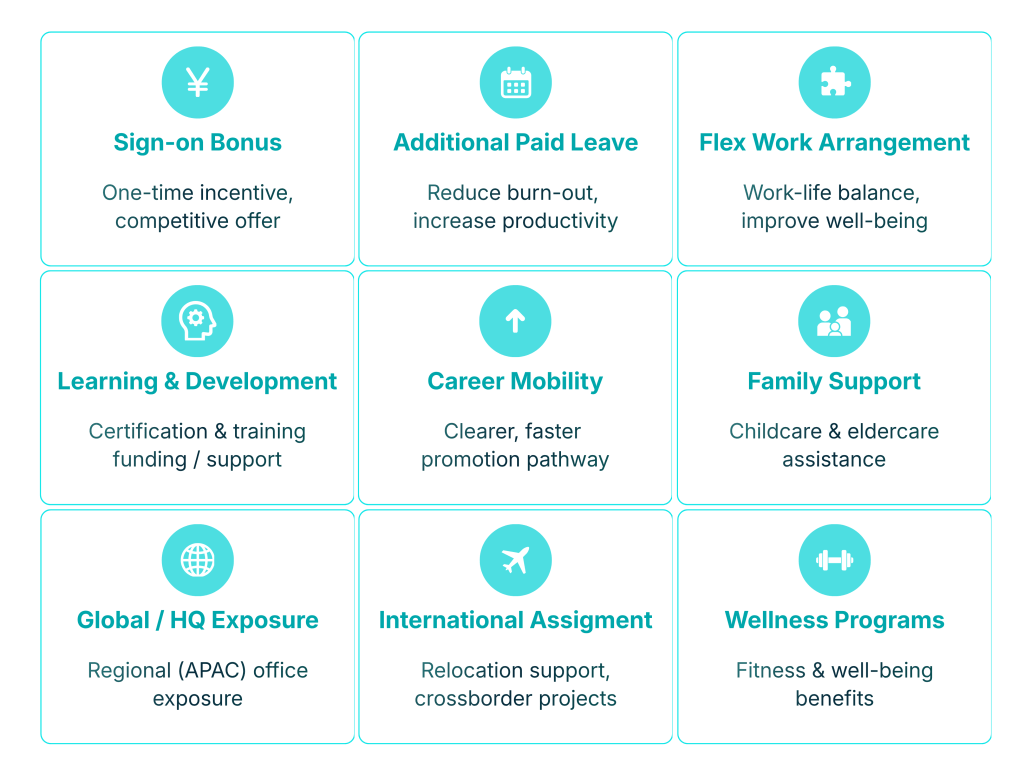
Compared to Q1 2026, overall salary levels remained relatively stable throughout the first half of the year. Rather than significantly increasing base salaries across the board, many employers focused on providing additional perks. These additional benefits help employers differentiate themselves without fundamentally changing salary structures.

Examples of benefits that companies may offer:

Additional benefits companies offer to stay competitive in hiring

Talent Insights

1. Candidate Availability

  • Japan continues to face a shortage of bilingual candidates, and demand for this talent pool keeps growing.

  • Accounting talent remained the most sought after throughout H1 2026 and is expected to continue into the second half of the year.

Why Japan Faces a Shortage of Accounting Professionals?

Approximately 10 years ago, many companies moved their accounting function offshore to reduce costs, resulting in a decrease in the number of accounting positions available domestically. Thus, many accounting professionals and younger talent redirected their skills into finance and other functions instead.

Offshore accounting teams, however, often struggled with the country-specific nuances of Japanese accounting practice, and companies have increasingly been bringing the function back onshore over the past few years.

The challenge is that the domestic talent pipeline has become significantly smaller after years of reduced local hiring. Demand for experienced accountants has risen rapidly, while the available supply has struggled to recover.

2. Candidate Openness to Change

Many experienced Finance & Accounting professionals are not actively job hunting but are open to moving if an attractive opportunity comes along. Senior candidates in particular tend to be receptive to new opportunities. They are more engaged in confidential market conversations to understand future opportunities and benchmark their careers. This means attracting senior talent often requires a proactive approach rather than waiting for candidates to enter the market. 

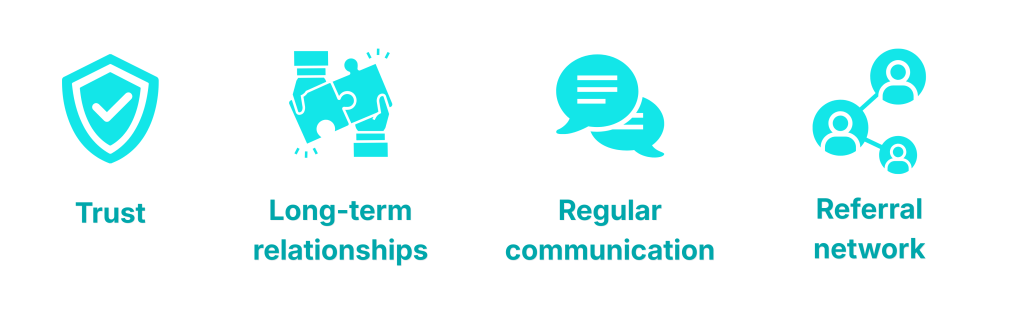
Because of this, traditional recruitment channels such as job boards and social media are becoming less effective in reaching strong Finance & Accounting candidates. Building long-term, trust-based relationships, maintaining regular communication, and developing referral networks are proving significantly more effective than relying solely on job advertisements. 

Successfully securing strong talent requires:

Traditional recruitment channels become less effective, trust and long-term relationship become utmost important

3. What Candidates Are Looking For

While compensation remains important, career decisions are increasingly influenced by a broader combination of professional and personal considerations. 

Based on our conversations throughout H1 2026, candidates most frequently prioritized: 

  • Long-term career development and progression 

  • The quality of leadership and immediate team 

  • Competitive compensation 

  • Hybrid working arrangements and workplace flexibility

4. Qualifications & Certifications

For Accounting professionals:  

  • CPA qualifications remain highly respected across the market.  

  • However, Trusted Partners has observed that CPA is no longer a mandatory requirement for most companies. 

  • Instead, Boki Level 2 is generally considered sufficient. 

Within FP&A: 

  • There are not many formal qualification requirements. 

  • Most companies prioritize advanced and hands-on Excel proficiency.

5. Technology Impact

Artificial Intelligence (AI) continues to influence the Finance & Accounting profession as organizations accelerate its adoption in business. Many finance professionals actively take part in learning and utilizing AI in daily workflow. Hiring managers are also becoming more likely to incorporate AI-related questions into their interview process. 

Below are findings from our AI in Finance & Accounting in Japan (2026 Report):

Finding 1: More Finance Functions Enhanced with AI Adoption

Finding 1: More Finance Functions Enhanced with AI Adoption

Finding 2: Human Skills Are Becoming More Important, Not Less

Human Skills Are Becoming More Important, Not Less

Outlook for H2 2026

We expect hiring activity to remain positive and increase in H2 2026, consistent with the growing volume of job openings seen through H1. The continued expansion of multinational corporations, ongoing investment from globally focused Japanese companies, and increasing finance transformation initiatives are expected to support sustained hiring demand.

1. Trends We Expect to Continue

  • Continued demand for Accounting professionals 

  • Finance transformation remains a priority 

  • Competition for bilingual talent 

  • Technology will become a greater differentiator 

2. Seasonal Hiring Considerations

One factor employers should be aware of is the seasonal slowdown that typically occurs during August. 

With the Obon holiday period in Japan coinciding with summer holidays across Europe and North America, recruitment processes involving regional or global stakeholders may temporarily slow. 

While hiring activity often softens during this period, we expect recruitment momentum to recover from September onwards as organizations resume hiring plans for the remainder of the year.

3. Key Takeaways for Employers

Move efficiently: Lengthy recruitment processes increase the risk of losing strong candidates to competing opportunities. Streamlining interview stages and maintaining clear communication can significantly improve hiring outcomes. 

Offer a compelling employee value proposition: While competitive compensation remains important, candidates increasingly evaluate opportunities based on career progression, leadership quality, organizational culture, flexibility, and professional development. 

Communicate clearly: Clearly defined hybrid working policies, transparent recruitment timelines, and consistent candidate communication help build confidence throughout the hiring process. 

Invest in long-term talent relationships: Many of the strongest finance professionals are passive candidates who are unlikely to respond to job advertisements. Building trusted relationships before hiring needs arise is becoming an increasingly important recruitment strategy. 

Prepare for continued competition: The shortage of bilingual Accounting professionals is expected to continue well beyond H2 2026. Organizations that proactively engage talent and move decisively will remain best positioned to secure the strongest candidates.

Share this article

LinkedIn
Email
X

More to explore

the cfo in the age of ai
Market Intelligence

The CFO in the Age of AI

From AP automation to real-time forecasting, Japan’s CFOs are navigating AI transformation. See what’s working, what isn’t, and what separates the leaders.

Read More »

グローバル自動車会社のファイナンスディレクター:

「彼は私がこれまでに働いた中で最も優れたエージェントであり、強くお勧めします。常に責任を持って関わってくれ、的確で意味のあるサポートをタイムリーに提供し、素晴らしいアドバイスをしてくれます。求職活動で成功したいなら、彼に相談することをお勧めします。」

化学製造会社の社長:

「ラヒムは、私が一緒に働いたことがあるリクルーターの中で最も才能ある1人です。彼はクライアントと候補者の幅広いネットワークを持っています。特に感銘を受けたのは、候補者に対して的確なアドバイスを行う能力です。これはすべてのリクルーターができることではありません。さらに、彼は候補者のキャリアに対して長期的な視野を持っていますので、彼の推薦と貴重な意見は頼りになります。」

米国の半導体メーカーの日本財務責任者:

「2016年、私が日本にオペレーションを持つ大手アメリカの半導体メーカーで財務オペレーションを管理していた際、ラヒムは私たちにとって重要なディビジョンコントローラーの役割に最も適した候補者を見つけてくれました。他のリクルーターにはできなかったことです。私たちが求める条件に当てはまる候補者を見つけることはまさに至難の業でした。ハイテク企業でビジネスの意思決定サポートを提供した豊富な経験を持つファイナンスの専門家であること、英語と日本語がネイティブレベルで流暢であること、東京の外で働くことを厭わないこと。このハードルの高い条件を全て満たす適切な候補者をラヒムは見つけ出したのです。私はその後、米国に戻りましたが、ラヒムの紹介により配属が決まった候補者は日本で順調に業務を遂行しており、会社も候補者もラヒムが提供した優れたサービスに非常に満足しています。将来的に再びラヒムと一緒に仕事をする機会を持てることを願っています。」

Director of Finance at Global Automotive Company

He is the best agent I have ever worked with and is highly recommendable. He had been always committed, provided valuable and meaningful support in a timely manner and gave great advice. If you are looking for success in job hunting, I suggest you get connected with him.

President of Chemical Manufacturing Company

Rahim is one of the most talened recruiters I have worked with in my business life. He has a broad-ranging of “quality” network with clients and candidates. And what I was impressed about him is his capability of precise advice to the candidate(s) to visualize one’s value as well as the path to higher value. This is not what every recruiter does. Last but not least, he has a long-term thinking on candidate(s) career, so you can rely on his recommendation and valuable input.

Japan Head of Finance, US Semiconductor Firm

In 2016 when I was managing the finance operations of a large American semiconductor firm with operations in Japan, Rahim was able to place exactly the right candidate for a key division controller role, a task that other recruiters had not been able to help us with. We were hoping to find a finance expert with plenty of hands-on experience providing business decision support in a high-tech company, who had near-native fluency in both English and Japanese and would be eager to live and work well outside of comfortable Tokyo. Truly a needle in a haystack, yet Rahim found the right candidate. I’ve since moved back to the US, but the candidate Rahim placed is thriving in his role in Japan, and the company is very happy with both the candidate and the excellent service Rahim provided. I hope to have the opportunity to work with Rahim again in the future.